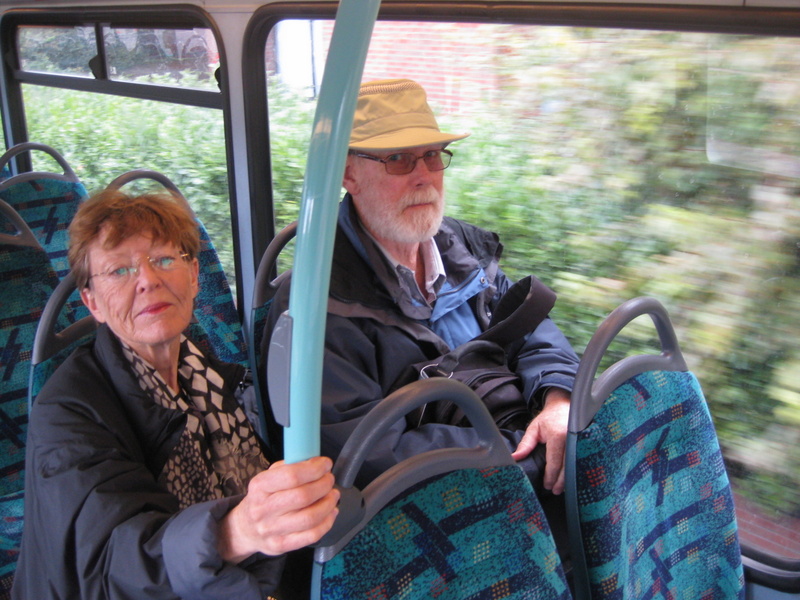
Okay, this is London and we're shortly about to leave it to return to Portugal. Luckily I checked our tickets this morning and found that I'd booked us back on 20 November instead of October. Hoo boy! This is the kind of thing it's not fun or cheap to discover shortly before leaving for the airport. Meanwhile......
This is Edgar, who is one of the principal residents at the home of Llewellyn and Lucia in Hanwell, London, where we stayed. Edgar is very big. It is fortunate that he is mild-mannered and very well disposed towards guests. He never fails to attract attention in the pubs he often visits with his humans.
Next meet Hazel. Hazel is not small, except by comparison with Edgar. She too likes guests and encourages them to scratch her head when they're not otherwise engaged. The pair of them are permitted to make themselves at home on the family sofa, except when the humans are having a TV meal there.
Tigger is one of the two household cats. He is very outgoing, loves company and is liable to join humans in bed in night where the first indication of his presence can be needles in one's leg. Tigger's companion, Charles Brown, is somewhat camera-shy and declined to appear on the blog.
The humans and canines in the household are very fond of one another. The humans take the dogs walking twice a day. The dogs are exceptionally well behaved. This is generally true of the humans as well. It's surprising how many creatures can fit amicably on the same sofa.
Llewellyn is a high-tech sort of a person who possesses every manner of electrical wizardry, all of which comes together in ways that ordinary mortals are unable to fathom. He is often to be found on the sofa, issuing computer commands to distant pieces of equipment, which sing or dance accordingly.
Barbara was wont to make herself comfortable in an easy chair in the lounge over a magazine or a conversation. Although it is not evident from the picture, Llewellyn has done an enormous amount of work in the living room following the purchase of the house last December.
He is also an excellent cook and is often to be found in the adjoining kitchen, where Barbara now stands. From the kitchen, a long narrow garden leads some 50 metres to the River Brent, which joins the Grand Union Canal a little further along.
The house is brilliantly situated for bus, tube and rail. It's barely 15 minutes into Paddington on the Heathrow Connect train that stops at Hanwell station, 10 minutes' walk away - 9 if the park is still open.
Among the first things we did on arrival in London was to replenish our Oyster cards, which serve for all the above means of travel. And in four days we did a great deal of hopping on and off of buses. On several occasions, younger passengers offered us their seats, a gesture as kind as it is unsettling.
And we took a good many tubes (metro/underground)and trains as well. Lucia, here pictured beside me, commutes two hours a day into and out of central London - a journey that will shrink to a fraction of that time when the Crossrail project is completed in a few years' time.
Here we are outside the Royal Academy in Picadilly, where Barbara and Llewellyn had spent a couple of hours at the Bronze exhibition. I spent them in the nearby Hatchards bookstore, where I acquired a copy of Spell it out, David Crystal's excellent account of how English spelling came to be so complicated.
Church Street market is a stroll away from our old London lodgings in Maida Vale, once a favourite destination for Barbara on an off-day from her job at NBC. Strange how all the stall holders look and sound so alike. At least a dozen of them were selling suitcases.
John Betjeman's statue stands proudly in the stunning concourse of St Pancras International station, where the Eurostar begins and ends its journeys to the Continent. We watched one of the trains gliding in to stop beside us - still impressive, however many years on.
Equally impressive is the new concourse on neighbouring Kings Cross, similarly surrounded by smart shops and cafes. We refreshed ourselves at the Patisserie Valerie where the staff, as so often in London, were from the European mainland, frequently from Poland.
Richard and Penny, friends hailing from way back, have recently completed a project to establish an outside studio room at their Islington home, situated below what was once their raised garage. It's very smart, overlooking the courtyard that separates it from the house.
Access is gained via a passage which also serves as an artwork in itself. Richard and Penny are both interested in art and supportive of local artists. They are rightly proud of this particular project although, they confess, it cost them years of sweat and tears as well as lots of lucre. (Those rings are part of the art!)
Another outing was to the new Westfield shopping centre close to the BBC's vast old headquarters in Shepherds Bush. I fear that the great variety of upmarket shops will drain away custom from central London, as has been the pattern elsewhere. Why go into the West End when it's all available here?
Two old friends from SABC days, Malcolm and Gary, have recently moved to Eastbourne, where we went to catch up on old times and admire their new quarters. Our admiration was sincere - they made a brilliant buy - and we liked the local pub just as much. Time to head to the airport. Enough unto the day!
Stats
Saturday, October 20, 2012
Sunday, October 14, 2012
Letter from northern Portugal
Tuesday morning last we gave the dogs a hug, waved Anne and Ian goodbye and took the road to Guarda in northern Portugal where we checked into the Residencial Santos, the interior design of which we liked a lot. It was all great stone walls, floating timber staircases and nooks to sit and browse. Pity that they'd given away the special room we'd booked.
The residencial was just around the corner from the old city, which featured the usual large square and towering cathedral. The area had a tired look about it, as if it had succumbed to the economic crisis. Several of the shops had signs seeking new occupants.
The square was clearly a popular gathering area. We seated ourselves at a cafe to watch the world go past. Jones clicked away with the camera. That was before I discovered that I hadn't brought the second half of the cord to recharge the battery.
I particularly liked this picture. The two girls sat exchanging news for a time in that intense way that women have, before consulting those all-important mobile phones.
In the centre of the square two large dogs lay sleeping in the afternoon sun, ignoring the commotion of traffic and passage of pedestrians around them. They were obviously very much at home on what they considered their turf. They were not so fast asleep that they didn't spring to life on the approach of another large dog,
a handsome retriever sort.
The pair of them followed the retriever - here hidden behind the car mirror - hackles raised, for several minutes, making it clear that he was anything but welcome. I feared the fur would fly.
But the resident canines contented themselves with butt-sniffing, huffing and puffing, and having the final word at the urinal. As dogs are wont to say, he who pisses last pisses longest.
As usual, we wandered the streets of the old town.
Shops came in three classes: empty, selling upmarket women's clothes, or given over to supplying refreshments of one sort of another. One street featured a string of restaurants. They weren't doing very well. We were the only clients in the first we visited, and shared another with one other diner.
A big new shopping centre on the outskirts of the city had clearly stolen much of their custom.
Just around the corner from the residencial, stairs led up through an ancient tower, in the corner of which was this unusual shrine.
Guarda is the highest city in Portugal and liable to extremes of weather. We found the October evenings surprisingly mild and I wished for either a fan or an air-conditioner to stir the air in the room at night. The best we could do was to leave the window open, inviting in the street noise as well as a breeze.
What the residencial also lacked was private parking. The nearest free parking, about 50 yards away, was much sought after, with drivers sitting and waiting for a spot to come free. We were lucky on the two days we stayed in the city to find parking with relative ease.
From Guarda we crossed the Spanish border to visit Ciudad Rodrigo, a city as ancient and brimful of violent history as any in this region. The central square is a good place to start, with coffee and a map donated by a helpful Spanish tourist. The map didn't help much nor could we easily distinguish one yellow stone building from another.
The old city lies totally within the battlements that, sadly, failed to protect its inhabitants from the French in 1810 or the British two years later. Both attacking armies pounded holes in the walls before sacking the place. Being sacked was something that the inhabitants, down the centuries, endured too often for comfort.
In one of the squares, a Spanish film or TV team was making a movie. Dirt had been scattered around to hide the cobbles and actor priests went through their lines in front of the camera while the rest of the team and the public huddled round.
It's a world neither of us misses.
Ancient stone animal carvings - dating back several thousand years - are a feature of northern Iberia, with religious and iconic symbolism. The pig is particularly popular, a much prized walking larder. This specimen might have been carved yesterday for all the impact the millennia had made on him.
From Guarda we drove north to the little town of Mirando do Douro where I'd made a four-day reservation at the Estalagem Santa Catarina overlooking the Douro River and a hydro-electric dam. The view speaks for itself. The road to Spain ran across the dam before coiling up the hillsides in both directions.
"Estalagem" is a class of comfortable hotels, generally set in the countryside. Ours was certainly comfortable - spacious and laid back. Our only complaint was about the spring-loaded doors that slammed all day and half the night - a failing that I pointed out to the management.
The second day of our stay in Miranda brought thousands of Spaniards streaming across the river into the town on what, we gathered, was a Spanish holiday. They descended on Miranda for its textiles; there are dozens of shops selling them - linen, blankets, towels and clothes. Most visitors clutched bags of purchases.
Just above the hotel lies the walled old city, where numbers of Mirandese still live. This gargoyle dating back a few centuries, indicated that the residence was a house of easy virtue - or at least a venue where instruction was available in the arts of love. What's new?
We had puzzled over the double signage in Miranda in what appeared to be Portuguese and Spanish. It wasn't Spanish, the museum curator explained, but Mirandese, a language close to Spanish which, she said, was spoken in the surrounding villages and had been recognised as Portugal's second tongue.
From Miranda it's a bit over an hour to Branganca, where we headed as ever to the historical area. By this stage, our camera battery had given up the ghost and we were dependent on my mobile phone for pictures. A large statue at the foot of Branganca castle paid homage to Alphonso the 1st (or 2nd?), who evidently did something useful.
It was almost certainly something to do with chasing out the Moors, although the Christians waged bloody wars among themselves for control of their dominions. Little wonder that people built walls so thick and high in the hope of protecting their interests.
Our final Spanish excursion was to the city of Zamora, a city much warred over by Christians and Moors for the better part of three centuries. The citadel has been restored most attractively, and the ancient castle with its keep was a magnet for scores of visitors, who paraded around its ramparts.
This area of Portugal and neighbouring Spain is marked by the construction of unusual stone walls. Large stones are set in the earth as pillars, with smaller stones subsequently packed between them. There's no sign of concrete to bind the stones. Even so, the walls seem to shrug off the years.
The residencial was just around the corner from the old city, which featured the usual large square and towering cathedral. The area had a tired look about it, as if it had succumbed to the economic crisis. Several of the shops had signs seeking new occupants.
The square was clearly a popular gathering area. We seated ourselves at a cafe to watch the world go past. Jones clicked away with the camera. That was before I discovered that I hadn't brought the second half of the cord to recharge the battery.
I particularly liked this picture. The two girls sat exchanging news for a time in that intense way that women have, before consulting those all-important mobile phones.
In the centre of the square two large dogs lay sleeping in the afternoon sun, ignoring the commotion of traffic and passage of pedestrians around them. They were obviously very much at home on what they considered their turf. They were not so fast asleep that they didn't spring to life on the approach of another large dog,
a handsome retriever sort.
The pair of them followed the retriever - here hidden behind the car mirror - hackles raised, for several minutes, making it clear that he was anything but welcome. I feared the fur would fly.
But the resident canines contented themselves with butt-sniffing, huffing and puffing, and having the final word at the urinal. As dogs are wont to say, he who pisses last pisses longest.
As usual, we wandered the streets of the old town.
Shops came in three classes: empty, selling upmarket women's clothes, or given over to supplying refreshments of one sort of another. One street featured a string of restaurants. They weren't doing very well. We were the only clients in the first we visited, and shared another with one other diner.
A big new shopping centre on the outskirts of the city had clearly stolen much of their custom.
Just around the corner from the residencial, stairs led up through an ancient tower, in the corner of which was this unusual shrine.
Guarda is the highest city in Portugal and liable to extremes of weather. We found the October evenings surprisingly mild and I wished for either a fan or an air-conditioner to stir the air in the room at night. The best we could do was to leave the window open, inviting in the street noise as well as a breeze.
What the residencial also lacked was private parking. The nearest free parking, about 50 yards away, was much sought after, with drivers sitting and waiting for a spot to come free. We were lucky on the two days we stayed in the city to find parking with relative ease.
From Guarda we crossed the Spanish border to visit Ciudad Rodrigo, a city as ancient and brimful of violent history as any in this region. The central square is a good place to start, with coffee and a map donated by a helpful Spanish tourist. The map didn't help much nor could we easily distinguish one yellow stone building from another.
The old city lies totally within the battlements that, sadly, failed to protect its inhabitants from the French in 1810 or the British two years later. Both attacking armies pounded holes in the walls before sacking the place. Being sacked was something that the inhabitants, down the centuries, endured too often for comfort.
In one of the squares, a Spanish film or TV team was making a movie. Dirt had been scattered around to hide the cobbles and actor priests went through their lines in front of the camera while the rest of the team and the public huddled round.
It's a world neither of us misses.
Ancient stone animal carvings - dating back several thousand years - are a feature of northern Iberia, with religious and iconic symbolism. The pig is particularly popular, a much prized walking larder. This specimen might have been carved yesterday for all the impact the millennia had made on him.
From Guarda we drove north to the little town of Mirando do Douro where I'd made a four-day reservation at the Estalagem Santa Catarina overlooking the Douro River and a hydro-electric dam. The view speaks for itself. The road to Spain ran across the dam before coiling up the hillsides in both directions.
"Estalagem" is a class of comfortable hotels, generally set in the countryside. Ours was certainly comfortable - spacious and laid back. Our only complaint was about the spring-loaded doors that slammed all day and half the night - a failing that I pointed out to the management.
The second day of our stay in Miranda brought thousands of Spaniards streaming across the river into the town on what, we gathered, was a Spanish holiday. They descended on Miranda for its textiles; there are dozens of shops selling them - linen, blankets, towels and clothes. Most visitors clutched bags of purchases.
Just above the hotel lies the walled old city, where numbers of Mirandese still live. This gargoyle dating back a few centuries, indicated that the residence was a house of easy virtue - or at least a venue where instruction was available in the arts of love. What's new?
We had puzzled over the double signage in Miranda in what appeared to be Portuguese and Spanish. It wasn't Spanish, the museum curator explained, but Mirandese, a language close to Spanish which, she said, was spoken in the surrounding villages and had been recognised as Portugal's second tongue.
From Miranda it's a bit over an hour to Branganca, where we headed as ever to the historical area. By this stage, our camera battery had given up the ghost and we were dependent on my mobile phone for pictures. A large statue at the foot of Branganca castle paid homage to Alphonso the 1st (or 2nd?), who evidently did something useful.
It was almost certainly something to do with chasing out the Moors, although the Christians waged bloody wars among themselves for control of their dominions. Little wonder that people built walls so thick and high in the hope of protecting their interests.
Our final Spanish excursion was to the city of Zamora, a city much warred over by Christians and Moors for the better part of three centuries. The citadel has been restored most attractively, and the ancient castle with its keep was a magnet for scores of visitors, who paraded around its ramparts.
This area of Portugal and neighbouring Spain is marked by the construction of unusual stone walls. Large stones are set in the earth as pillars, with smaller stones subsequently packed between them. There's no sign of concrete to bind the stones. Even so, the walls seem to shrug off the years.
Friday, October 05, 2012
Letter from Espargal: 34 of 2012
This – if I could nail the moment to the floor – is Thursday night. It has been a very busy Thursday day. Yes, I know that’s redundant. We set out at 11.00 to take Olive to the bank, the post office and the shops. You might think that easy enough but you’d be wrong. The first challenge is to get ourselves out of the gates while keeping the dogs in.
Since the electric motor unit controlling the left gate gave up the ghost earlier in the week, we’ve had to open the left gate by hand – my job; Jones bribes the dogs to stay in the yard while I take out the car. The right gate still opens with the remote.
That’s to say, it did, until we came home to find that puppy had chewed up the remote, as well as demolishing in seconds her indestructible new toy.
But I run ahead of myself. As I say, we set out to fetch Olive. En route we stopped in Loule for coffee and a cake at the “Barclays” café, so-called because it’s situated near the bank (avoid Barclays Portugal like the plague – a story for another day). This café does the best rice cakes in town; we always share one and we stop there as often as we can.
THE CHEWER
Then we continued to fetch Olive from her home near Almancil. The banking and the shopping were straightforward, calling only for a little patience. Fetching the mail from the post office box proved more challenging. Olive couldn’t find the key to her postbox (because it was still hanging in our key cupboard – yet another story!). So we had to persuade a member of the post office staff to fetch the contents from the box.
The contents were problematic – various querulous statements and allegedly overdue bills that had to be sorted out promptly – for Friday is a holiday – Republic Day - and we’re away next week. So instead of dropping Olive back home and returning to Espargal for my siesta as planned, we carried on to the Algarve Forum on the outskirts of Faro.
An hour later, all was resolved: her phone bill, her internet connection, her electricity bill and her computer cord. It felt like hard work, especially a long phone call in Portuguese on a bad line to the electricity supplier. If she ever won the lottery, I informed Olive, I wanted half. Olive said sorry, she didn’t do the lottery.
On Wednesday, Sergio called twice. Sergio is a beefy Ukrainian who works for Segurdecor, the Loule company that installed our electric gates. In the morning, he arrived in response to my SOS to ascertain why the motor no longer opened our left gate. (I strongly suspect that it was because the dogs had been leaping up on to the motor arm to look through the gates!) It would be necessary, Sergio told us, to disconnect the motor drive and take it into the workshop. Go right ahead, we said.
In the afternoon, he brought it back – repaired. The boss had replaced a damaged cog and checked the motor; it was fine. This was music to our ears. But, once the unit had been bolted back into place, it still refused to open the gate. With a sigh, Sergio disconnected it a second time and took it back to the workshop. Later he called to say it was graunched and would need replacing. Did we have €500 for a new one?
Also on Wednesday, we joined friends for lunch at the Hamburgo in Benafim. It was lovely to sit in the shade of the bougainvillea and quaff leisurely beers over easy conversations. They didn’t seem to mind that we’d arrived half an hour late - because Sergio had turned up just as we were about to leave. Sod’s law!
LAST YEAR'S PICTURE
At the adjacent table, the archaeological team from the University of Jena was also having lunch. Afterwards, we took the friends around to the dig in an Espargal field where the bronzed young Germans were shifting rocks and sand. Archeology is hard work. I take them icecreams once or twice a week, a gesture they greatly appreciate in the Algarve sun. Jones is convinced that I have fallen in love.
On Tuesday we drove to the “lagar” on the outskirts of the town of Sao Bras. The word “lagar” translates as “press”. But the lagar in question is a small factory, where all sorts of agricultural products are processed in time-honoured fashion. Here people bring the remains from the pressings of grapes and figs, to be turned into liquor – and olives to be pressed into oil.
With us we had two plastic sacks of pomace (in Portuguese 'bagaço') that Leonhilde had given us, the residue from her wine pressing. After weighing the contents, an assistant at the lagar informed us that these entitled us to two litres of baggy – Jones’s favourite tipple – to be dispensed from a tap at the base of a giant tank. Thank you, we said, passing over two five-litre plastic bottles, and could we purchase 8 litres more. The price is really a bargain – a couple of euros a litre.
I went across to the office to pay the bill. The manager hauled out a book from under the counter to note down the purchase with his pencil. Spotting bottles of medronho on display, I asked to buy one - to present to Llewellyn, Barbara’s brother, whom we plan to see in London in a couple of weeks.
Yes of course, said the manager, going on to indicate that one could save several euros by purchasing an unfranked bottle if one didn't need a receipt. We came away with three bottles instead of one. As we returned home with our booty, we reflected on the principles of rural economics and the ethics of paying taxes. (There’s been an outcry over the income tax increases just announced by the Portuguese government as it tries to balance its ailing budget.)
On Monday, we joined May and her nephew Ken – down from Scotland – for lunch, with Ono and Pricks between our feet under the restaurant table. May is our other widow lady; we generally take her shopping and to lunch at the start of the week.
We have advised her that we shall be away for the best part of a fortnight. We are setting out on Tuesday to spend several days in the north of Portugal before returning to Lisbon – where we’ll leave the car at the airport - and spending four days in London.
Regrettably, the trip clashes with the start of the new academic year at the Senior University and will disrupt my English lesson schedule.
Our weather continues summery. After a couple of days of rain – when we celebrated our first fire in the stove, for cosiness rather than warmth – the sun has returned with a vengeance.
Jonesy is watering her garden once again and the bees are crowding around our water points. We took an afternoon, Jones on one side of the fence and I on the other, to cut back a honeysuckle hedge that had gone completely bananas. Jonesy assures me that it will soon enough grow again.
I have hung bird-seed fingers from the trees in the hope of attracting more birds to the garden but the birds have ignored them. Only the sparrows sport noisily in the trees, as usual. Of the rest we hear more than we see. The doves call for much of the day and at sundown there’s the plaintive whoo of the owl from the valley.
At that hour, after feeding the dogs, we sit back on the front patio to contemplate the day, Jonesy over a baggy and I over a whisky. I have bought a real whisky glass, a lead crystal tumbler, the better to enjoy my evening tot. It’s a
"remainder" that I found marked at half-price in town. Lead crystal is painfully expensive. On the other hand, it seems to age whisky to a mellowness well beyond the reach of other glasses.
It’s time for bed – for puzzled dreams of being back in the monks or of roaming disconsolately around the BBC newsroom. Or maybe of snuggling up to Jones – with the big hairy gooseberry, Ono, snoring gently on the bed between us. P.S. Mary has just demolished a new watch that Jones intended as a gift. Only the plastic strap remained. Jones got down on her knees to listen to Mary's tummy in case the watch was inside her. Happily, we found it elsewhere. (It may be a while before the next blog!)
Since the electric motor unit controlling the left gate gave up the ghost earlier in the week, we’ve had to open the left gate by hand – my job; Jones bribes the dogs to stay in the yard while I take out the car. The right gate still opens with the remote.
That’s to say, it did, until we came home to find that puppy had chewed up the remote, as well as demolishing in seconds her indestructible new toy.
But I run ahead of myself. As I say, we set out to fetch Olive. En route we stopped in Loule for coffee and a cake at the “Barclays” café, so-called because it’s situated near the bank (avoid Barclays Portugal like the plague – a story for another day). This café does the best rice cakes in town; we always share one and we stop there as often as we can.
THE CHEWER
Then we continued to fetch Olive from her home near Almancil. The banking and the shopping were straightforward, calling only for a little patience. Fetching the mail from the post office box proved more challenging. Olive couldn’t find the key to her postbox (because it was still hanging in our key cupboard – yet another story!). So we had to persuade a member of the post office staff to fetch the contents from the box.
The contents were problematic – various querulous statements and allegedly overdue bills that had to be sorted out promptly – for Friday is a holiday – Republic Day - and we’re away next week. So instead of dropping Olive back home and returning to Espargal for my siesta as planned, we carried on to the Algarve Forum on the outskirts of Faro.
An hour later, all was resolved: her phone bill, her internet connection, her electricity bill and her computer cord. It felt like hard work, especially a long phone call in Portuguese on a bad line to the electricity supplier. If she ever won the lottery, I informed Olive, I wanted half. Olive said sorry, she didn’t do the lottery.
On Wednesday, Sergio called twice. Sergio is a beefy Ukrainian who works for Segurdecor, the Loule company that installed our electric gates. In the morning, he arrived in response to my SOS to ascertain why the motor no longer opened our left gate. (I strongly suspect that it was because the dogs had been leaping up on to the motor arm to look through the gates!) It would be necessary, Sergio told us, to disconnect the motor drive and take it into the workshop. Go right ahead, we said.
In the afternoon, he brought it back – repaired. The boss had replaced a damaged cog and checked the motor; it was fine. This was music to our ears. But, once the unit had been bolted back into place, it still refused to open the gate. With a sigh, Sergio disconnected it a second time and took it back to the workshop. Later he called to say it was graunched and would need replacing. Did we have €500 for a new one?
Also on Wednesday, we joined friends for lunch at the Hamburgo in Benafim. It was lovely to sit in the shade of the bougainvillea and quaff leisurely beers over easy conversations. They didn’t seem to mind that we’d arrived half an hour late - because Sergio had turned up just as we were about to leave. Sod’s law!
LAST YEAR'S PICTURE
At the adjacent table, the archaeological team from the University of Jena was also having lunch. Afterwards, we took the friends around to the dig in an Espargal field where the bronzed young Germans were shifting rocks and sand. Archeology is hard work. I take them icecreams once or twice a week, a gesture they greatly appreciate in the Algarve sun. Jones is convinced that I have fallen in love.
On Tuesday we drove to the “lagar” on the outskirts of the town of Sao Bras. The word “lagar” translates as “press”. But the lagar in question is a small factory, where all sorts of agricultural products are processed in time-honoured fashion. Here people bring the remains from the pressings of grapes and figs, to be turned into liquor – and olives to be pressed into oil.
With us we had two plastic sacks of pomace (in Portuguese 'bagaço') that Leonhilde had given us, the residue from her wine pressing. After weighing the contents, an assistant at the lagar informed us that these entitled us to two litres of baggy – Jones’s favourite tipple – to be dispensed from a tap at the base of a giant tank. Thank you, we said, passing over two five-litre plastic bottles, and could we purchase 8 litres more. The price is really a bargain – a couple of euros a litre.
I went across to the office to pay the bill. The manager hauled out a book from under the counter to note down the purchase with his pencil. Spotting bottles of medronho on display, I asked to buy one - to present to Llewellyn, Barbara’s brother, whom we plan to see in London in a couple of weeks.
Yes of course, said the manager, going on to indicate that one could save several euros by purchasing an unfranked bottle if one didn't need a receipt. We came away with three bottles instead of one. As we returned home with our booty, we reflected on the principles of rural economics and the ethics of paying taxes. (There’s been an outcry over the income tax increases just announced by the Portuguese government as it tries to balance its ailing budget.)
On Monday, we joined May and her nephew Ken – down from Scotland – for lunch, with Ono and Pricks between our feet under the restaurant table. May is our other widow lady; we generally take her shopping and to lunch at the start of the week.
We have advised her that we shall be away for the best part of a fortnight. We are setting out on Tuesday to spend several days in the north of Portugal before returning to Lisbon – where we’ll leave the car at the airport - and spending four days in London.
Regrettably, the trip clashes with the start of the new academic year at the Senior University and will disrupt my English lesson schedule.
Our weather continues summery. After a couple of days of rain – when we celebrated our first fire in the stove, for cosiness rather than warmth – the sun has returned with a vengeance.
Jonesy is watering her garden once again and the bees are crowding around our water points. We took an afternoon, Jones on one side of the fence and I on the other, to cut back a honeysuckle hedge that had gone completely bananas. Jonesy assures me that it will soon enough grow again.
I have hung bird-seed fingers from the trees in the hope of attracting more birds to the garden but the birds have ignored them. Only the sparrows sport noisily in the trees, as usual. Of the rest we hear more than we see. The doves call for much of the day and at sundown there’s the plaintive whoo of the owl from the valley.
At that hour, after feeding the dogs, we sit back on the front patio to contemplate the day, Jonesy over a baggy and I over a whisky. I have bought a real whisky glass, a lead crystal tumbler, the better to enjoy my evening tot. It’s a
"remainder" that I found marked at half-price in town. Lead crystal is painfully expensive. On the other hand, it seems to age whisky to a mellowness well beyond the reach of other glasses.
It’s time for bed – for puzzled dreams of being back in the monks or of roaming disconsolately around the BBC newsroom. Or maybe of snuggling up to Jones – with the big hairy gooseberry, Ono, snoring gently on the bed between us. P.S. Mary has just demolished a new watch that Jones intended as a gift. Only the plastic strap remained. Jones got down on her knees to listen to Mary's tummy in case the watch was inside her. Happily, we found it elsewhere. (It may be a while before the next blog!)
Subscribe to:
Posts (Atom)