Stats

Friday, June 10, 2011

Letter from Espargal: 21 of 2011

We’re home from the sea. The dogs have given us a licking-good welcome. The cats have returned from the hiding places they take up during our absences. Our house sitters have gone. So too has the rain that fell in generous quantities during their stay.

Jones has been catching up with the neighbours as well as cutting back and watering the garden. I’ve been strimming every blade of grass in sight – more thistles and dandelions, actually, than grass. Our suitcases are back up in the roomy bedroom cupboards. We’ve been through the post and caught up with correspondence. The amazing cruise is just a memory.

But since I have very little else to write about, let me finish my account of that cruise with the “Behind the scenes” ship’s tour that we took on our final day at sea. It lasted well over two hours.

First came an introduction by the “hotel director”, a senior officer who was responsible for 800 of the 950 crew on board. As he pointed out, a cruise boat is really just a travelling hotel and it has to provide all the same facilities. Most important of these, arguably, are the extensive kitchens.

The head chef, who hailed from the Caribbean, conducted us around them, explaining how everything worked. With two thousand passengers (and, of course, nearly a thousand crew) to feed each day, they don’t stop. Food is available somewhere on the ship night and day. Jones and I thought that the meals were very good, with a wide choice of dishes, although we confined ourselves to the buffet restaurant.

The downside was the loud pop-music that boomed out relentlessly from numerous ceiling speakers and, on busy days, the difficulty of finding a table. Whenever conditions allowed, we’d eat out on the open rear deck instead. The liner also had two large “sit down” restaurants and half a dozen (entrance fee) speciality restaurants.

I have to say that the kitchens gleamed. They’re stainless steel throughout on tiled floors. The chef said that on the last inspection, the ship had been penalised one point out of 100 – because some of the kitchen tiles were cracked. Even so, 99% isn’t a bad pass.

Then down to the 3rd deck, where most of the crew live and work. A wide corridor known as Route 95 runs the length of the ship. This deck is also the location of the vast storerooms that hold the ship’s supplies. The ship stocks up once every nine days during the passenger “turn around” in Copenhagen.

Still on the 3rd deck is the ship’s laundry which, like much of the ship, works in shifts to cope with the load.

Apart from bedclothes and passengers’ personal belongings, the laundry deals with up to six thousand linen table napkins a day. We watched in fascination as great machines gobbled up wet napkins and spat them out, dry and ironed, a few seconds later.

Back upstairs then, for a backstage walk-through of the ship’s 800-seat theatre. The only fascinating bit of that, for me, was to observe the magician’s doves and rabbit resting peacefully in their cages.

His cat and his (very large green) snake, we learned, lived with him and his wife in their cabin. Their act was easily for us the highlight of the entertainment, most of which tended to be animated song and dance routines. The ship's orchestra and various musicians did their thing in the numerous bars and lounges, where passengers were encouraged to buy drinks at painfully high prices.

The highlight of the tour was undoubted the visit to the bridge. We were most impressed that the captain, a Norwegian, gave up 15 minutes of his time to explain just how things worked. The ship had adopted an aircraft style cockpit, housing two officers and a range of instruments. A third officer was on watch at the windows.
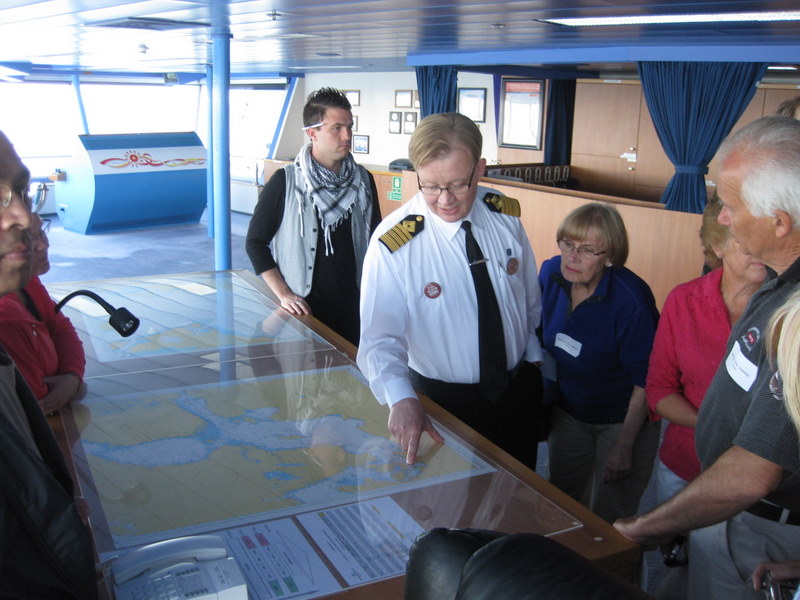
The Baltic, as we learned, is very shallow. Cruise liners follow carefully plotted and marked channels and even these leave big ships with little to spare. Ours drew 8 metres and the channel we were following at the time in what seemed like the middle of the ocean was barely 18 metres deep.

To the side of the bridge, a desk held a variety of computerised equipment that the skipper could use independently of the cockpit. A shipping ID system enabled him to click on any of the dots on a screen representing other ships and immediately to obtain all the details of their name, home port, cargo, destination and itinerary.

The top toy was a handle that controlled the ship’s propellors, rudder and thrusters. When docking or departing, the skipper had only to point this handle in the desired direction and the computer did the rest. Little wonder that he seemed to berth his 80,000 tonner more easily than we moored our houseboat on the Alqueva Dam.

Saturday morning we arrived back in Copenhagen shortly after dawn. We tied up at the edge of a container port, much to Jones’s annoyance, for she was determined not to pay for either a taxi or the coaches that had been laid on. In the event, a commuter bus dropped us at the harbour gates and we had the choice of a train or bus into town.

The rest of the day we wandered around. Copenhagen has much to offer although we were disappointed by the state of some pavements, littered with cigarette butts, papers and broken glass. Those Danes are not as clean living as you might suppose.

Sunday we flew home. Our suitcases were first off the carousel. The Ferretts were waiting for us in the terminal. The rest you know.

Friday, June 03, 2011

Letter from Stockholm

Thursday 2 June: Stockholm is our final port of call but there’s no room for us in the harbour. We anchor offshore at the port of Nynashamn. Buses are to take us 45 minutes up the highway to Stockholm itself. The ship’s tenders are lowered to take passengers ashore. Jonesy takes photos of the action.

It’s quite dramatic watching the tenders being swung out from the deck and lowered 100 feet into the water. We make our way down to the 3rd deck with hundreds of other passengers. The sea is choppy and one has to board the tender with care.

It’s a catamaran capable of taking well over 100 people. The boat’s nose goes up as the pilot opens the throttles. The twin propellors pack a punch. Passengers disembark at the floating dock and make their way up to the coach park.

We have booked a “highlights” tour of Stockholm. Our coach has broken down, we learn. A replacement is on its way. It arrives and we set off. I snooze most of the way. In Stockholm an elderly guide joins the coach. She is enthusiastic and knowledgeable. Not a building escapes her attention.

We stop on a hill for a view of the city and the main harbour. Stockholm is truly beautiful, a city of islands, bays and bridges. For two hours the coach takes us on a tour of the city, past the buildings of state and government, past parks, across bridges, through the suburbs. We are shown some mega-expensive apartments, one of which belongs to Bjorn Borg. Everwhere, boats are tied up in little bays and inlets.

I am disappointed that there’s no opportunity to get off and wander around. It’s my own fault. I booked the wrong tour.

Back to the hotel to drop the guide and a chance for a welcome beer. I have to change euros for Swedish crowns at the desk. Then it’s back down the highway to Nynashamn again.

NYNASHAMN COACH PARK

Jones and I decide that another visit to Stockholm is a must. We have three hours before we must rejoin the ship. We wander up the road for a look at the little town. As in Stockholm, there are great outcrops of granite to be seen on all sides. It’s a public holiday, Ascension Thursday, and the place is fast asleep.

An old lady is taking her cat for a walk. There’s a little more action at the port where a ferry is loading. I need a pee and Jones has forbidden me from using the bushes. So it’s back to the coach park. We chat to the young women running the visitors’ shop. Their English is good. Jones chooses a few souvenirs. I get another t-shirt.

Back on to the tender for a choppy ride back to the ship and some welcome late afternoon tea (i.e. a pint of Boddington’s ale). More pictures as the tenders are hauled back on board. The operation is swift and practised. We’re impressed.

After supper, we make our way to the 12th deck observation lounge for a malt whisky (our first) and some reflective conversation. Our voyage is nearly over. We have Friday at sea. We have booked a "behind the scenes" tour of the ship, including a visit to the bridge.

Saturday morning early we dock In Copenhagen. Sunday we fly home.

Letter from Helsinki

Wednesday 1 June: It’s another beautiful day. We slide gently into our berth in Helsinki. Other cruise ships are already tied up. We haven’t booked a tour and are not in a rush. First we take a leisurely breakfast on deck. The choice of food in the buffet restaurant is excellent.

Then downstairs to Deck 3 where we are checked out of the ship by the crew, who slide our ID cards through a reader. The Hop-on Hop-off buses are waiting. We hop on. Upstairs, in the open top bus, the commentary is hard to hear and out of sync.

The bus takes us on a tour of the city. Helsinki is bigger than we expect, home to half a million people plus. We love the leafy parks. Some of the locals have found themselves grassy spots to celebrate the sunshine.

We hop off again and make our way to the modern art gallery. The exhibition is a temporary one, not of Finnish art as we expect, but of African art. Jonesy likes the South African artists best.

A few blocks further we visit a church hewn out of rock. The walls are rough red granite. Only the roof protrudes.

The dome is supported by a ring of curved beams. The interior is truly beautiful. Everwhere, tourists are taking pictures, as we are ourselves. We resent their chatter.

Then back on foot through the city centre to the open air market. Jonesy stops at a stall where a woman is selling one-off items of jewellery and designer table wear, made from titanium, steel and aluminium.

The stall holder is pleased to tell us about her craft. She's not at all pushy. We buy a pendant from her. It’s very unusual and most attractive.

Nearby, the city hall has an exhibition of 1930’s pictures. We are taken by a remarkable work of art - a chain-work of giant, linked fingers.

It sits on top of one mirror and below another, creating an illusion of huge depth. Jones tries to take pictures from several angles.


We decide to walk the two miles back to the ship. All the signs are both in Swedish, which we can make out, and Finnish, which is a mystery to us. The shoreline is edged with parks, rocky beaches and marinas. The marinas sit partly within natural walls of large boulders. This place is simply made for boats.

Around us the people of Helsinki are walking their babes and their dogs, sunbathing on the grass or the sands, talking in a language of which we understand nothing.

We feel very much at ease. We stop for refreshments at a kiosk whose owner speaks excellent English. She was born in the US, she confesses. Jones is anxious that we're heading in the right direction. It's ok. We can see the ship in the distance.

When we get back to the ship I reward myself with two cans of Boddingtons’ ale from the Sports Bar. At 1730 the engines rumble, the side thrusters whirr into action, the water churns beneath us and we head slowly out towards our final port of call, Stockholm.

Wednesday, June 01, 2011

Letter from Russia

Monday 30:
We berth in St Petersburg, the highpoint of our voyage, the only city where we stay for two days. As we quickly discover, the city simply overwhelms one. A potted history: The population is 4.5 million people.

MAIN SQUARE - SNATCHED FROM BUS
The city was established in 1703 by Peter the Great on marshy land. He was a great admirer of things European and hoped vainly to institute a system of canals like those of Venice. Many buildings are slipping slowly into the marsh.

Like Copenhagen and Helsinki, it’s a key port embracing dozens of interlinked islands. The climate isn’t great. St Petersburg enjoys only some 60 sunny days a year and we had two of them.

The first day starts out bright and early in the ship’s theatre; we are sorted into groups. Thence to the terminal building where we join the queue of passengers waiting to be processed. Russian immigration officials scrutinise our landing cards and passports. We're through. To the fleet of buses. Ours is number 16.

Awaiting us are Nadya and Julia, our guides, both 30-something, slim and unsmiling. But like Irina and Tatiana the following day they prove to be very good at their jobs and we warm to them. They lead us around like mother hens, waving numbered flags above their heads. The main attractions in St Petersburg are huge and so is the number of their visitors. So it’s very easy to get lost. The guides wear neck-mics and issue their groups with earphones, which helps.

Our immediate destination is Peterhof, the summer palace of the tsars, situated on the bay - about an hour’s drive. After a "comfort stop" at a souvenir shop (all such stops take place at souvenir shops), we arrive. Peterhof is stunning, utterly overwhelming in scale and its sheer glittering gold-leafed, magnificence.

To protect the extensive parquet floors, laid out in exquisite patterns, we are issued with elasticised over-shoes. For over an hour, we follow Julia through the great halls, corridors and reception rooms of the palace. The building was intended to awe the tsar’s visitors and it awes us. No luxury was spared. The palace suffered during three years of Nazi occupation. Of the damage no sign remains. Refurbishment and restoration continue unceasingly.

After lunch, we make our way past the multiple gilded statues and gravity-fed fountains to the far end of the gardens, where a hydrofoil awaits us. We zip back to the city for a visit to the fortified island at the heart of St Petersburg.

Within its walls stands the historic church of St Peter and St Paul, golden domed like all churches. Inside are the tombs in white Carrara marble of the later tsars, including the unfortunate Nicholas II and his family.

We are led into a small chapel to hear a stunning rendition of Russian a capella singing by a small choir intent on raising money for a new stained glass window. The CDs are expensive but we buy one anyhow. Their harmonies are perfect. Their bass singer hits low notes that I last heard from Paul Robeson.

Back at the dock, the immigration officials check us back in just as carefully as they earlier let us through. This is Russia. Elsewhere, a cursory glance at the ship’s ID-key card, issued to all passengers, has sufficed.

Tuesday 31:
We are on an afternoon visit to The Hermitage Museum, the home of St Petersburg’s art collection. Irina and Tatiana prove just as accomplished as their colleagues the previous day. Once again, the visitor is overwhelmed.

The collection was begun in the then Tsars’ Winter Palace by Catherine the Great for her own private purposes. As it grew, so did the need for more space. After the communist revolution, all private collections were nationalised. This great hoard is now housed in five buildings, including the Winter Palace, all interconnected in a vast complex. We follow Tatiana through an endless series of rooms, upstairs and down.

The Hermitage (so called because Catherine, a French-speaker, liked to think of herself as a hermit, alone with her collection) holds three million objects; only 10% of them are on public view. New buildings are planned to exhibit more of them. Once again, the scale and magnificence of the palace leaves one bereft of words.

The highlight of the tour for many visitors is the carefully guarded “gold room”, the storehouse of hundreds of solid gold artifacts, most obtained from burial mounds across a sweep of Europe and Asia. Tatiana translates the detailed account given to us by an elderly expert.

Finally we are whirled through hall after hall of old and recent Masters. Tatiana points out the two or three most important paintings of each artist and gives us a few seconds to take in another score or so. The tour is designed to give one just a taste of what The Hermitage holds. To get to know its contents would take years.

We sail out of St Petersburg on the most beautiful of summer evenings. (Sunset is after 11 pm) Jones and I join hundreds of other passengers on the ship’s extensive decks. The first 90 minutes of our passage is across a shallow, narrow bay, along a channel.

KOTLIN ISLAND

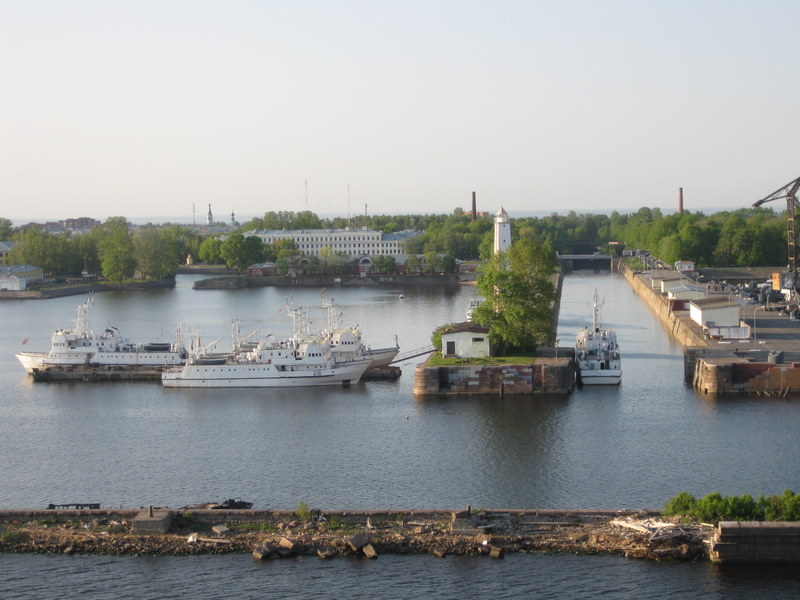
Then we slow down to pass through massive sea-gates beside the island of Kotlin. On both sides of us, great causeways run a total of 25 kilometres to the mainland. This is a huge flood barrier, intended to prevent storm surges from inundating St Petersburg, a city often flooded in the past.

Letter from Tallinn

Saturday 28 May. We have a day at sea. That’s fine by us. Whenever we stop over we feel compelled to explore and it gets exhausting. So we wander around the ship instead. Her heart is the multi-deck atrium (with fancy glass elevators) where the desks are situated in the midst of bars, restaurants, shops, lounges, the casino, the internet lobby and much else.

The casino hasn’t tempted us, nor (so far) have the pools, jacuzzis, shops, chapel, spa or gymnasium. But we have made use of the library (fleetingly), the theatre, the lounges, coffee bars and (especially) buffet restaurants.

200 METRE CORRIDOR

At the Reception Desk we meet two South Africans, one of them the purser. There are at least three Afrikaans speaking couples on the voyage. Most of the passengers are English speaking, with lots of Spanish speakers, many Germans and a contingent of Chinese. The few French feel ill-catered for, as Jones learns from a French couple later.

On sea days, the ship lays on additional entertainment. Passengers are invited to dress formally (we lack the clothes) and to meet the captain (we decline.) The official photographer snaps away, as she does at every opportunity.

We attend a talk on amber by the jewellery shop owner. Most of the world’s amber comes from the Baltic. It’s a useful talk, despite the marketing, as we learn how to distinguish the real stuff from the fake.

Another talk – on The Hermitage Museum in St Petersburg – by the ship’s art auctioneer is similarly useful. Thanks, but no thanks, we are not buying any art on this voyage.

Jones drags me up for some vigorous circuits of the deck. Three times around is a mile (it feels like two). She’s faster than I am and pulls ahead but I cut through the ship to come out in front. Somehow, although I continue slogging around, she loses me and spends 30 minutes searching the ship for me. She can’t believe that I was still doing circuits.

Sunday 29: We arrive in the Estonian capital Tallinn to find two big cruise ships already tied up there. On the far side of the terminal a line of coaches waits.

Beyond the ship ferries come and go. The Hop-on Hop-off buses are lining up just beyond the quay. Plug in your headphones and choose your language.

We get off at the high point of the old city. Several thousand other tourists are there already and the place heaves. With hundreds of others we edge our way into the Orthodox Cathedral, where the worshippers – at the front of the church – are vastly outnumbered by the gapers.

All are standing, responding to the chanting of a grey-bearded priest up front. There are no pews in Orthodox churches and services last some three hours, we learn later. Not for the faint-hearted. The priest disappears through an invisible door and we too take our leave.

Out again, into the alleys of old Tallinn, along with the chattering, picture-snapping crowds.

The old town is the centre of government and diplomacy. But only the tourists are in evidence.

We work our way downwards, stopping at a coffee shop for refreshments and a pee. There’s a line for the single multi-sex toilet which, as we discover, is normal in Tallinn.

Down again, past endless souvenir shops to the central square, bedecked with flags and full of market stalls. Linen, mohair and trinkets are much in evidence.

We lunch at a stall selling sausages, salad, salmon and sauerkraut. It’s good, especially with an affordable beer (me) and glass of wine (her).

Some kind of festival is taking place. Groups in folk costumes parade past us, some singing.

RIVAL CRUISE SHIPS

Back to the ship on foot. Dozens of stalls have been set up within the port. We explore them.

Beside us, sheep graze on the grass, indifferent to the tourists. Their world at least hasn't changed.

Blog Archive